Managed vs Self Hosted Database: Which Is Better for Your Startup?
For years, most teams have defaulted to managed database services. They’re easy to set up, require minimal operational effort, and let developers focus on building products instead of managing infrastructure.
But as systems grow, the trade-offs become harder to ignore.
Costs increase faster than expected.
Control becomes limited.
And optimisation starts to feel constrained by the platform itself.
This is where the conversation around managed vs self hosted database setups becomes important.
Teams now begin to ask:
- Is convenience worth the long-term cost?
- How much control do we actually need?
- And is there a better way to balance both?
In this guide, we’ll break down the differences between managed and self-hosted databases, where each approach works, where it falls short, and what modern teams are choosing instead.
Managed vs Self Hosted Database: What’s the Real Difference?
At a high level, the difference between a managed vs self hosted database comes down to one thing:
Who controls the infrastructure and operations.
1. Managed Database
With a managed database (like Amazon RDS, Google Cloud SQL, or Azure Database for PostgreSQL), the cloud provider handles most of the operational work:
- Setup and provisioning
- Backups and replication
- Monitoring and maintenance
- Infrastructure management
You interact with the database, but the underlying system is largely abstracted away.
This makes managed services ideal for:
- early-stage teams
- fast product development
- teams without dedicated DevOps resources
2. Self Hosted Database
A self-hosted database runs inside your own cloud infrastructure.
Instead of relying on a fully managed platform, you control:
- The cloud provider
- Region and deployment architecture
- Storage and compute resources
- Network and security configuration
This gives you full ownership and visibility over how your database operates.
But it also means: You are responsible for running and maintaining it.
The Core Trade-Off
- Managed = convenience and speed
- Self-hosted = control and flexibility
At first, managed databases feel like the obvious choice.
But as systems scale, many teams start reconsidering that decision, especially when cost, performance tuning, and infrastructure control become critical.
Why Teams Start with Managed Databases And Why It Stops Working
When teams evaluate a managed vs self hosted database, the decision almost always starts the same way.
They choose managed.
And it makes complete sense.
Managed databases are:
- quick to deploy
- easy to operate
- designed to remove infrastructure complexity
For early-stage startups, this convenience is not just helpful, it’s necessary.
You can launch faster.
You don’t need a DevOps team.
You don’t have to think about backups, failover, or monitoring.
So the decision feels obvious.
But here’s the pattern most teams don’t see coming:
What feels simple at the start becomes limiting at scale.
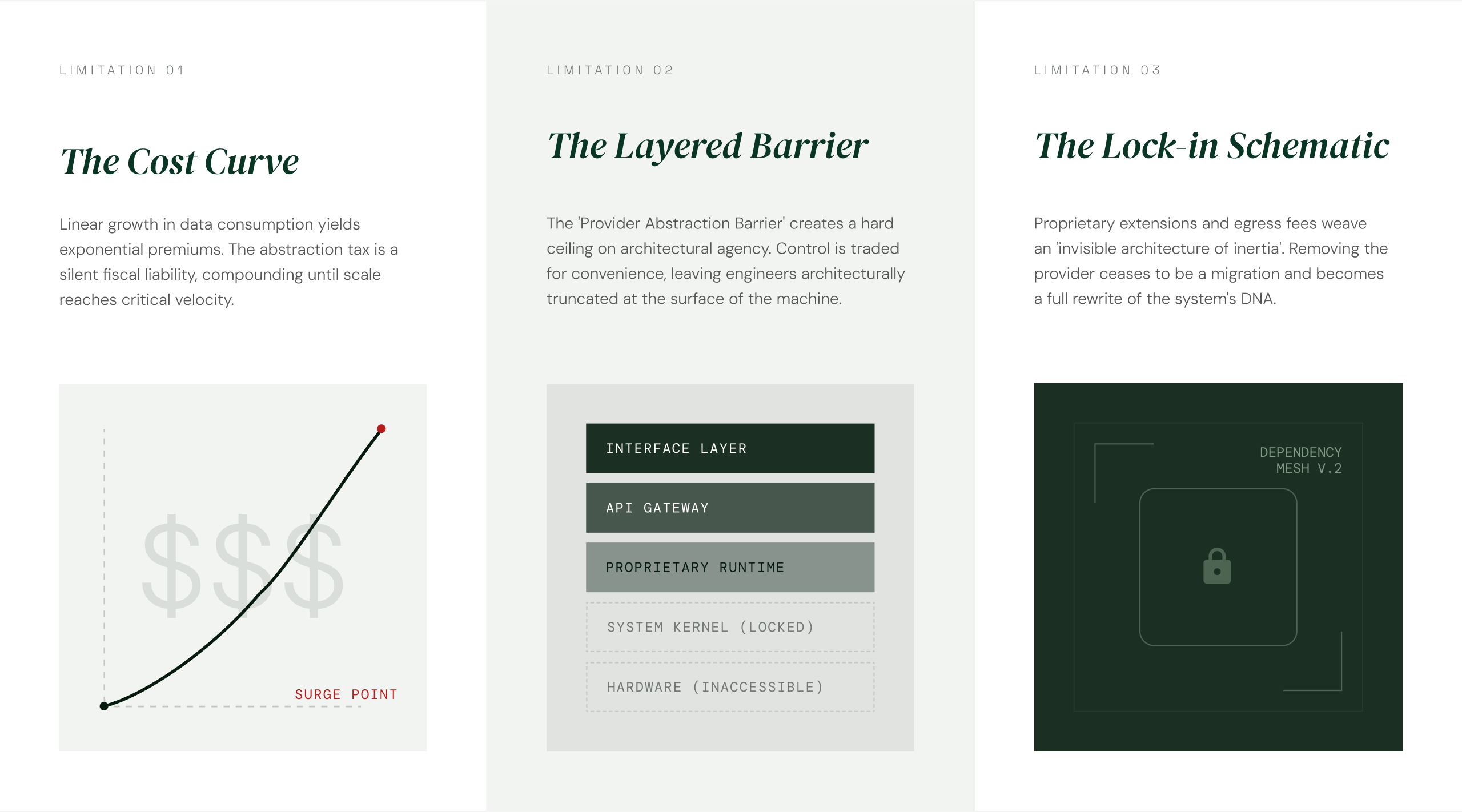
1. Costs Don’t Just Grow - They Compound
Managed platforms like Amazon RDS, Google Cloud SQL, and Azure Database for PostgreSQL are built for convenience.
But that convenience comes at a premium.
As usage grows, so do:
- compute costs
- storage costs
- replication costs
- backup and data transfer costs
What starts as a predictable monthly bill becomes increasingly difficult to control.
Industry comparisons of managed database pricing consistently show that costs scale faster than expected, especially as high-availability setups and read replicas are added (external reference: AWS RDS pricing comparisons, alternatives analysis).
The result:
You’re paying more, without gaining proportional control.
This isn’t theoretical.
A bootstrapped SaaS startup reduced their database costs by 50% after moving away from managed infrastructure, without sacrificing performance.
2. Control Is Limited Where It Matters Most
Managed services abstract away infrastructure.
That’s the benefit.
But it’s also the limitation.
With platforms like Amazon RDS, you don’t get full access to:
- underlying system configurations
- low-level performance tuning
- custom extensions or setups
Technical evaluations of managed services often highlight the lack of root-level access and restricted configurability, a limitation well documented in Amazon RDS limitations and widely discussed in expert reviews.
This becomes a problem when:
- performance issues arise
- debugging requires deeper visibility
- custom optimisation is needed
You’re operating inside boundaries you don’t control.
3. Architecture Constraints Start to Show
Every managed platform comes with predefined limits.
These include:
- scaling boundaries
- configuration restrictions
- provider-specific architecture decisions
Comparisons across managed PostgreSQL services (AWS RDS, Google Cloud SQL, Azure Database) show that these constraints vary, but they consistently exist across platforms, as seen in Cloud SQL for PostgreSQL limitations and differences from standard PostgreSQL.
Over time, this means:
You’re not designing your system freely.
You’re designing within a platform’s rules.
4. Vendor Lock-In Becomes a Strategic Risk
This is the part most teams underestimate.
Once your application is deeply integrated with a managed ecosystem, leaving becomes difficult.
Database vendor lock-in happens when:
- tooling is provider-specific
- configurations are tightly coupled
- migration becomes costly and risky
A challenge well documented in database vendor lock-in and its impact on modern applications.
5. Convenience Today Creates Complexity Tomorrow
Managed databases optimise for short-term speed.
But over time, they create dependencies, cost inefficiencies, and architectural rigidity that are difficult to undo.
The longer you rely on managed infrastructure, the harder it becomes to regain control.
In fact, for many teams, this becomes the real turning point.
A solo founder building a SaaS product realised that choosing secure PostgreSQL hosting early was not just a technical decision but it defined long-term flexibility and risk. (Internal link → Case Study: Secure PostgreSQL Hosting)
Across all of this, the pattern is consistent:
Managed databases optimise for convenience – not for long-term control.
And as systems grow:
For some teams, the next step is obvious:
Move toward self-hosting.
But that introduces a new problem entirely.
Self-Hosting Sounds Better - Until You Try to Run It
After understanding the limitations of managed services, many teams exploring a managed vs self hosted database setup naturally move toward self-hosting.
On paper, it looks like the obvious solution.
You get:
- full control over infrastructure
- freedom from vendor constraints
- better cost efficiency at scale
And importantly:
You’re no longer operating inside someone else’s system.
Why Self-Hosting Is So Attractive
Self-hosting gives teams something managed platforms can’t:
1. Real Infrastructure Ownership
Your database runs in your environment, within your security boundaries and architecture decisions.
2. Cost That Aligns With Usage
Instead of paying for bundled platform pricing, you pay for raw compute, storage, and networking. This is why many comparisons of AWS RDS alternatives highlight cost efficiency as a key reason teams move toward self-hosted setups, a trend clearly outlined in AWS RDS alternatives and cost comparisons.
3. Flexibility Without Platform Limits
You can:
- customise configurations
- optimise performance deeply
- design architecture based on your needs, not provider constraints
4. Freedom From Vendor Lock-In
You’re no longer tied to:
- proprietary tooling
- provider-specific limitations
- rigid pricing models
At this stage, the conclusion feels clear:
Self-hosting gives you everything managed services take away.
So Why Doesn’t Everyone Do It?
Because self-hosting shifts the burden entirely onto you.
And that burden is not small.
Running a production-grade database reliably requires:
- high availability architecture (multi-AZ setups)
- automated backups and verified recovery
- continuous monitoring and alerting
- performance tuning and optimisation
- security hardening
- patching and ongoing maintenance
These are not optional.
They are the difference between a working system and a failing one.
In practice, this is where most teams struggle.
A seed-stage startup trying to manage databases without dedicated DevOps resources quickly found that infrastructure complexity became a bottleneck to product development.
The Real Problem Isn’t the Database, It’s Operations
This is the part most comparisons miss.
Databases themselves are not difficult.
Running them reliably at scale is.
Self-hosting introduces:
- operational overhead
- infrastructure complexity
- constant maintenance responsibility
And for many teams, this creates a new trade-off:
Control vs operational burden
The Trade-Off No One Wants
At this point in the managed vs self hosted database decision, teams realise:
Managed → easy, but restrictive and expensive
Self-hosted → powerful, but complex and resource-heavy
Neither option fully solves the problem.
And this is where the real question begins:
Is it possible to get the control of self-hosting without the operational overhead?
The Third Model: Control Without the Operational Burden

For a long time, the managed vs self hosted database decision forced teams into a trade-off:
Choose managed → get simplicity, lose control
Choose self-hosted → gain control, take on complexity
But this is no longer the only way to think about database infrastructure.
A new approach is emerging:
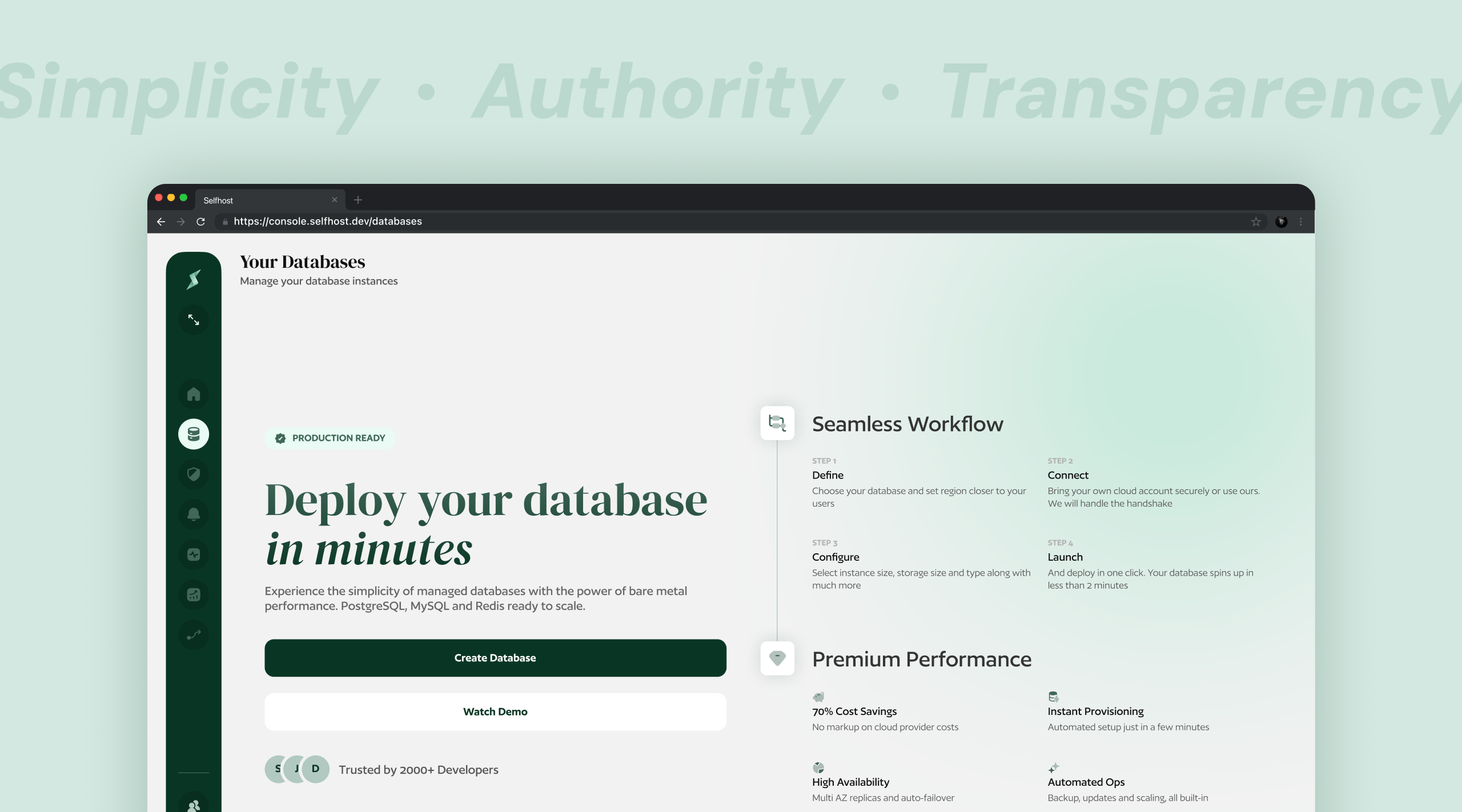
Fully managed databases, deployed in your own cloud environment
What This Model Actually Means
Instead of running your database inside a provider’s black-box platform:
- Your database runs in your cloud account (BYOC - Bring Your Own Cloud)
- You retain full ownership of infrastructure and data
- But the operational complexity is handled for you
In simple terms
You keep:
1. Control
2. Flexibility and;
3. Visibility
You remove:
1. Operational overhead
2. Infrastructure complexity
3. Constant maintenance burden
Platforms like SelfHost.dev are built around this model which allows a team to run fully managed databases inside their own cloud infrastructure without becoming database operations experts.
Why This Changes the Managed vs Self Hosted Debate
This approach removes the core limitation of both traditional options.
Compared to Managed Databases
You are no longer:
- locked into provider-specific ecosystems
- limited by platform constraints
- paying premium pricing for abstraction
Compared to Self-Hosting
You are no longer need to:
- design high-availability architectures from scratch
- build backup and recovery systems
- manage monitoring, alerting, and scaling manually
The trade-off disappears.
What Teams Actually Get With This Approach
Instead of assembling multiple tools and infrastructure layers, teams get:
1. Fast, Production-Ready Deployment
Provision fully managed databases in minutes, without complex setup workflows.
2. Built-In High Availability (Multi-AZ)
Reliable primary-replica setups with automated failover, something that is complex and error-prone in traditional self-hosting.
3. Centralised Operational Visibility
Reliable primary-replica setups with automated failover, something that is complex and error-prone in traditional self-hosting.
4. Deep Performance Insights Without Tooling Overhead
Access critical metrics like:
- IOPS and throughput
- connection utilisation
- replication lag
- cache performance
Without stitching together multiple monitoring systems.
5. Fully Managed Operations Behind the Scenes
Including:
- backups and recovery
- security hardening
- patching and updates
- real-time monitoring and alerting
All without taking control away from you.
Why Teams Are Moving Toward This Model
This shift is not theoretical.
Teams are actively moving away from traditional managed platforms because:
- costs scale unpredictably
- flexibility becomes limited
- infrastructure decisions become constrained
At the same time, fully self-hosting remains too operationally heavy for most teams.
This model solves both problems at once.
For example, teams that initially struggled with database operations complexity have been able to manage production systems without dedicated DevOps effort by adopting this approach.
Similarly, cost-conscious startups are increasingly choosing infrastructure models that allow them to optimise spending without sacrificing performance
Rethinking Your Database Strategy
The way teams manage databases is changing. What was once a forced trade-off between convenience and control is now evolving into something far more flexible.
Teams no longer need to accept high costs in exchange for simplicity, nor do they have to take on operational complexity just to gain control.
Today, it’s possible to achieve both without compromise.
With SelfHost.dev, teams can:
- run databases across multiple cloud providers
- choose between deploying in their own account or a managed environment
- maintain full visibility into performance and operations
- manage everything from a unified platform
- reduce database costs by up to 60% compared to traditional managed services
Instead of managing infrastructure, teams can focus on building.
Why Now Is the Right Time to Evaluate Alternatives
The shift toward cost efficiency, infrastructure ownership, and multi-cloud flexibility is already underway.
To support this transition, SelfHost is offering one year of free BYOC access for the first 100 teams. This allows you to test the model in your own cloud, validate performance and reliability, and explore cost savings without any upfront commitment.
If you’ve been reconsidering your current database setup, this is the simplest way to evaluate a better approach.
Explore SelfHost.dev and see how much control and cost efficiency you can gain.
Frequently Asked Questions
What is the difference between managed and self hosted databases?
A managed vs self hosted database comes down to control and responsibility. Managed databases handle infrastructure, backups, and maintenance for you, while self-hosted databases run in your own cloud environment with full control. The trade-off is simplicity versus flexibility. Managed is easier to start, while self-hosting gives deeper control over performance and cost.
Which is better: managed or self hosted database?
There’s no one-size-fits-all answer. In a managed vs self hosted database decision, managed works best for early-stage teams needing speed, while self-hosted suits teams that need control and cost efficiency at scale. The right choice depends on your stage, technical expertise, and long-term infrastructure goals.
Is self-hosting a database cheaper than managed services?
Yes, self-hosting is often cheaper at scale because you pay for raw infrastructure instead of bundled platform pricing. Managed services include convenience costs for automation, monitoring, and high availability. Over time, these add up, especially with replication and backups, making cost optimisation harder compared to self-managed setups.
Do you need DevOps expertise to manage a self hosted database?
In most cases, yes. Running a self-hosted database requires knowledge of infrastructure, backups, monitoring, and failover systems. Without proper expertise, managing reliability and performance becomes challenging. This is why many teams hesitate to move away from managed platforms despite wanting more control.
What are the risks of self-hosting a database?
The biggest risks are operational. These include downtime due to misconfigured failover, data loss from improper backups, and security vulnerabilities if systems aren’t maintained properly. Self-hosting gives control, but it also requires consistent monitoring, updates, and infrastructure discipline to avoid these issues.
Can you avoid vendor lock-in with self-hosted databases?
Yes. Self-hosting reduces vendor lock-in because your database runs in your own infrastructure, not inside a provider’s managed ecosystem. This gives you flexibility to change cloud providers, optimise costs, or redesign architecture without being tightly coupled to proprietary services or pricing models.
Is there a way to get the benefits of self-hosting without the complexity?
Yes. Newer approaches allow teams to run fully managed databases inside their own cloud environment. This model keeps infrastructure control while removing the operational burden of managing backups, scaling, and monitoring manually. It combines the advantages of both managed and self-hosted setups.
How are teams solving the managed vs self hosted database trade-off today?
Many teams are moving toward hybrid models that combine control with managed operations. In a modern managed vs self hosted database comparison, this approach removes the traditional trade-off by allowing databases to run in your own cloud while a platform handles operational complexity, improving both flexibility and efficiency.